

Revenue teams are about to ask more of every seller than they ever have, and they're counting on AI to make the math work.
AI in sales is the use of machine learning and generative AI across the revenue process, from deciding which accounts to pursue to writing outreach, logging activity, coaching reps and forecasting. Nearly every revenue team uses it now. In Boston Consulting Group's 2027 Revenue Agenda, a survey of 398 revenue leaders, 90% report meaningful AI use in sales, yet only 13% count better win rates among its top impacts and just 8% count higher quota attainment. Most of the gains so far are administrative. The teams turning AI into revenue point it at the decisions that come first: which companies fit your best customers, what proves value to them, and where reps should spend the time AI gives back.
BCG's 2027 Revenue Agenda report surveyed CROs, chief commercial officers, sales leaders and RevOps leaders across five sectors and 23 countries. Its central finding is that revenue leaders plan to grow almost everything at once next year, and the rest of the 2026 research shows how far AI still has to go to support that plan.
What "Do More With More" Means
BCG's headline finding is that revenue leaders aren't choosing between growth levers for 2027. They're pulling several at once.
- 65% expect sales headcount to grow over the next year, and 22% expect growth of more than 10%
- 72% expect sales and revenue budgets to increase
- 91% expect quotas or productivity requirements per seller to rise
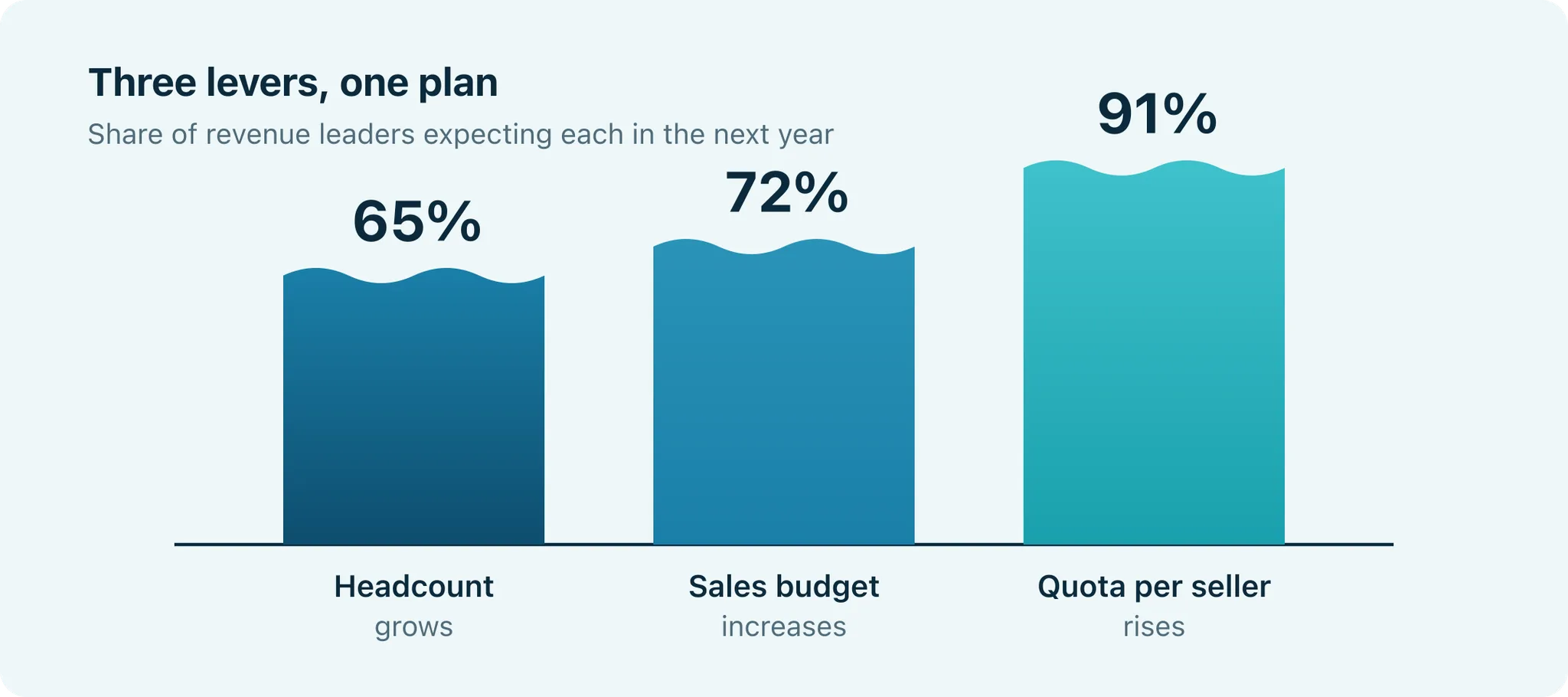
That combination is unusual. In most planning cycles, a company adds people or raises expectations on the people it has. In 2027, most are doing both, and they expect AI to cover the gap between today's output and next year's targets.
BCG's coauthors are direct about the risk. As BCG's press release puts it, the plans assume a productivity step-change that AI has not yet delivered. The gains so far are real, but they're mostly administrative and deal-support related. Turning them into win rates and quota attainment is the work ahead.
Where AI Is Paying Off
Almost every revenue organization uses AI in some form. Very few have gone deep with it, and the payoff so far shows up in the seller's day far more than in the customer's decision.
How Widely Are Sales Teams Using AI?
BCG found that 90% of companies report meaningful AI use in sales and revenue workflows, but only 6% have autonomous AI completing end-to-end workflows within governed limits. Salesloft's 2026 US Revenue Benchmark, a survey of 500 US sales and revenue decision-makers, found the same shape from a different angle: every respondent uses AI somewhere in the revenue process, yet only 20.6% describe it as production-ready with measurable outcomes.
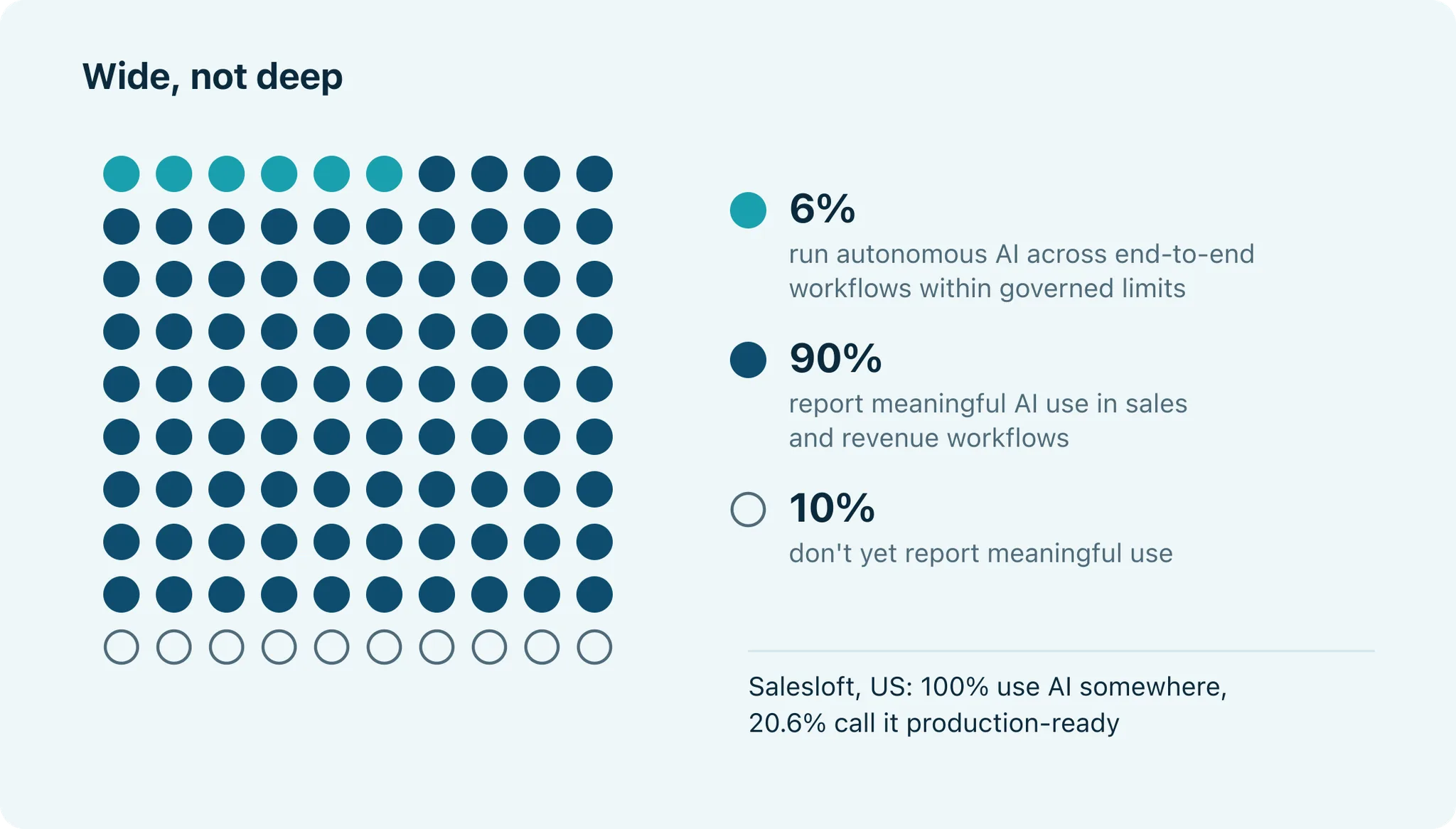
In practice, that usually means AI sits inside individual tools. A rep uses an assistant to draft emails. A manager gets call summaries. RevOps runs a forecasting model. Each piece helps, but few teams have connected AI to the full path from picking an account to closing it.
Where Does AI Improve Sales Results?
When BCG asked revenue leaders where AI is having measurable impact, the most common answers were operational:
| Area of AI impact | Share of leaders citing it |
|---|---|
| Reduced administrative workload | 33% |
| Seller time saved | 22% |
| Better coaching and enablement | 18% |
| Better forecast accuracy | 18% |
| Improved conversion | 14% |
| Improved win rate | 13% |
| Higher quota attainment | 8% |
The pattern is consistent. The top four impacts make selling easier for the seller. The bottom three are the ones a CFO cares about, and they trail by a wide margin.
None of this means the early gains are small. Giving reps back hours each week is valuable. The question BCG raises is what happens to those hours next.
Why Quota Attainment Keeps Slipping
Quotas are rising faster than attainment, and the gap between top performers and everyone else is wide. Three 2026 studies look at attainment from different angles:
- Gong Labs' State of Revenue AI 2026 analyzed 7.1 million opportunities across more than 3,600 companies and found rep quota attainment fell from 52% to 46%. Win rates and deal duration stayed roughly flat. Reps were working fewer opportunities.
- Bridge Group's 2026 AE quota research found 48% of reps achieved annual quota in 2026, down from 51% in 2024.
- Salesloft's benchmark puts average quota attainment near 62%, and found 68.4% of leaders reported higher pipeline quotas.
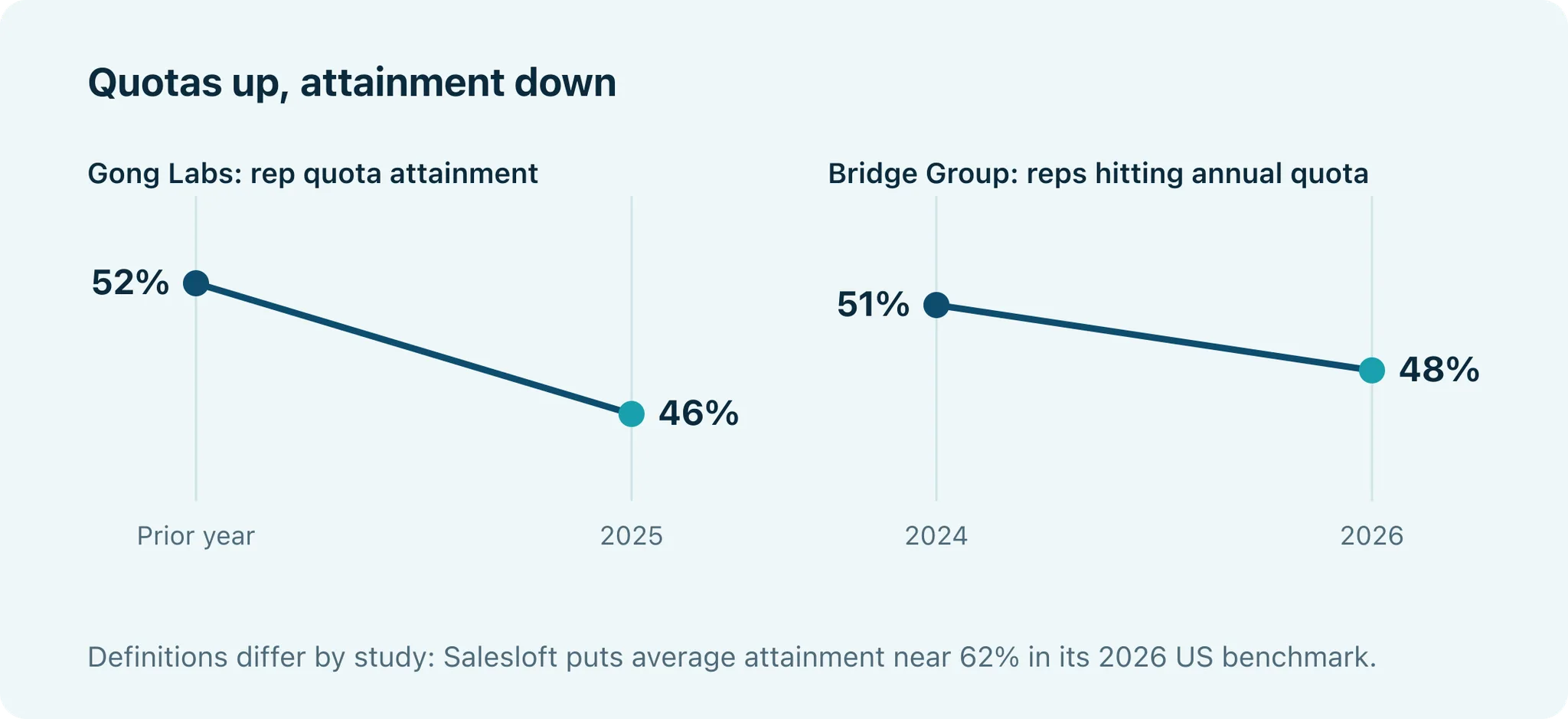
The numbers differ because each study defines attainment differently. The direction is what matters. Quota attainment isn't keeping pace with the 91% of leaders who expect quotas to rise.
Salesloft also found that the top 10% of sellers produce 47.4% of closed-won revenue. That concentration says a lot about where productivity really comes from. Top reps tend to know which accounts are worth their time. Average reps spend more of their week on accounts that were never likely to buy, and AI that only speeds up their activity doesn't change that.
Ocean.io's recommendations are built for that gap. Every account comes with a score, a tier and the reasons it fits, so the whole team works from the same account instincts your best closer took years to build.
How AI Is Changing B2B Buyers
AI isn't only changing how sellers work. It's changing who sellers meet at the first call.
BCG asked revenue leaders about the top impacts of customers' own AI use on their sales teams:
- Nearly 60% say customers arrive at the first conversation more informed about products, competitors and use cases than two years ago
- 54% report more demand for customer- or industry-specific personalization in proposals and outreach
- 51% say buyers expect more customized proof of value, including evidence of ROI, before buying
- 24% say internal consensus-building has gotten harder, as each stakeholder brings their own research and priorities
Buyer-side research tells the same story. The 6sense 2026 Global B2B Buyer Experience Report found buyers first engage sellers about 59% of the way through an average 10.3-month journey. By then, 91.4% have already ranked their shortlist, and the vendor they favored before first contact wins 82% of the time.
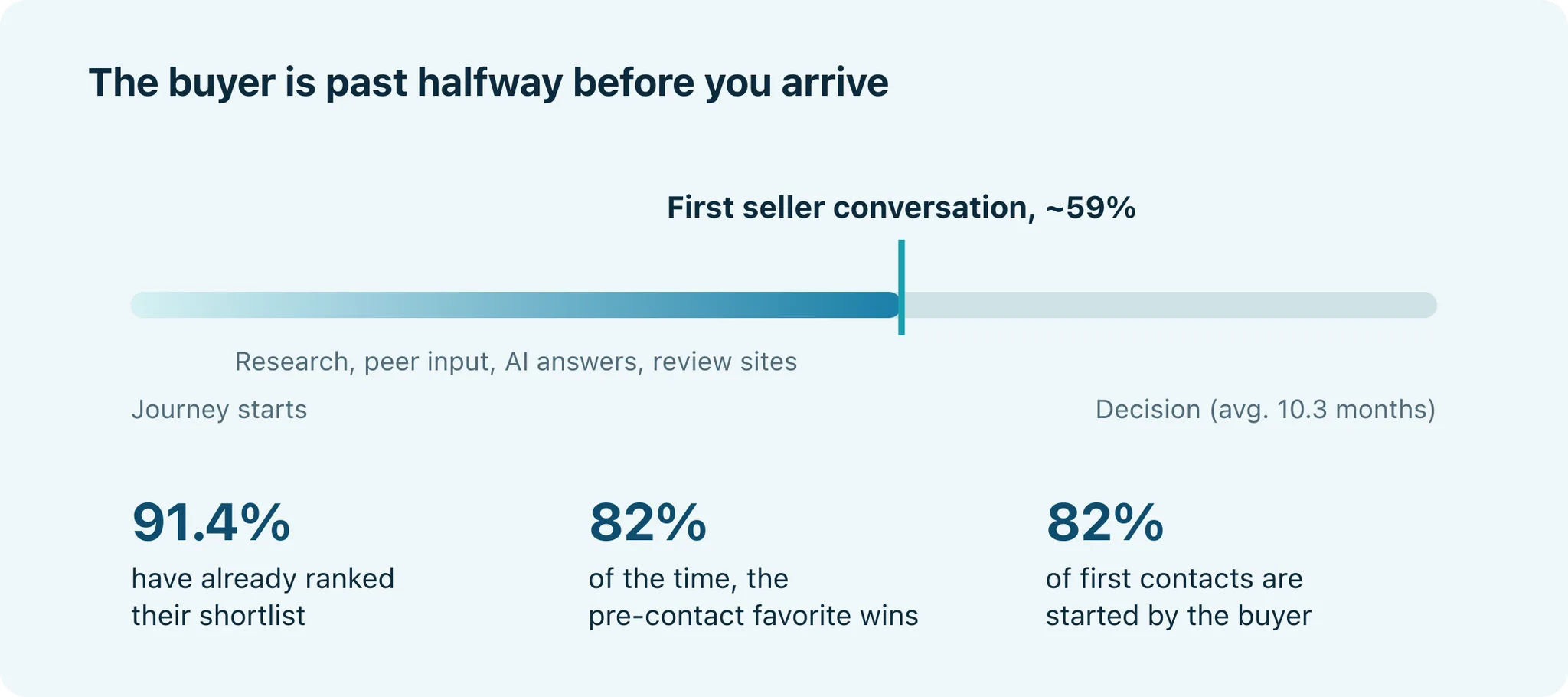
Where does that early research happen? G2's 2026 buyer behavior research found review sites (38%) have overtaken AI chatbots (37%) as the top source shaping which vendors make the shortlist. Buyers are asking AI assistants, reading reviews and comparing vendors well before anyone books a demo.
For sellers, that changes the job. A buyer who has already compared vendors and asked an AI assistant for a summary doesn't need a product overview. They need evidence that the seller understands their company specifically, and a credible case for value in their situation.
Why AI Gains Aren't Reaching Revenue
BCG names one mismatch directly, and the wider data points to two more.
Proof of Value Gets Too Little AI Attention
Buyers want customized proof earlier, yet only 32% of revenue leaders point to AI speeding up earlier proof-of-value activities. That's the moment when a seller can still change a skeptical buyer's mind, and it's under-invested.
Saved Time Flows Back Into the Same Pipeline
An hour saved on CRM updates is only as valuable as the account it gets spent on. When target accounts are picked from industry codes and headcount bands, AI helps reps work the same accounts faster. Gong's finding that reps worked fewer opportunities while win rates held flat suggests the quality of each opportunity matters more than it did. Ocean.io ranks every company in your market against your closed-won deals, so the time AI saves goes to accounts that look like your past wins.
Most Teams Can't See Why Deals Move
Salesloft found only 32% of leaders can instantly diagnose why a deal stalled. Another 41% are slow to find the cause or lack visibility, and 27% can see win and loss rates but can't explain what happened between stages. Without knowing what made past wins win, it's hard to point AI at more accounts like them.
What Do AI-Advanced Revenue Teams Do Differently?
BCG's survey offers an early look at the teams turning AI into commercial results. The more AI-advanced organizations, those with more autonomous agents deployed, stand apart on three measures:
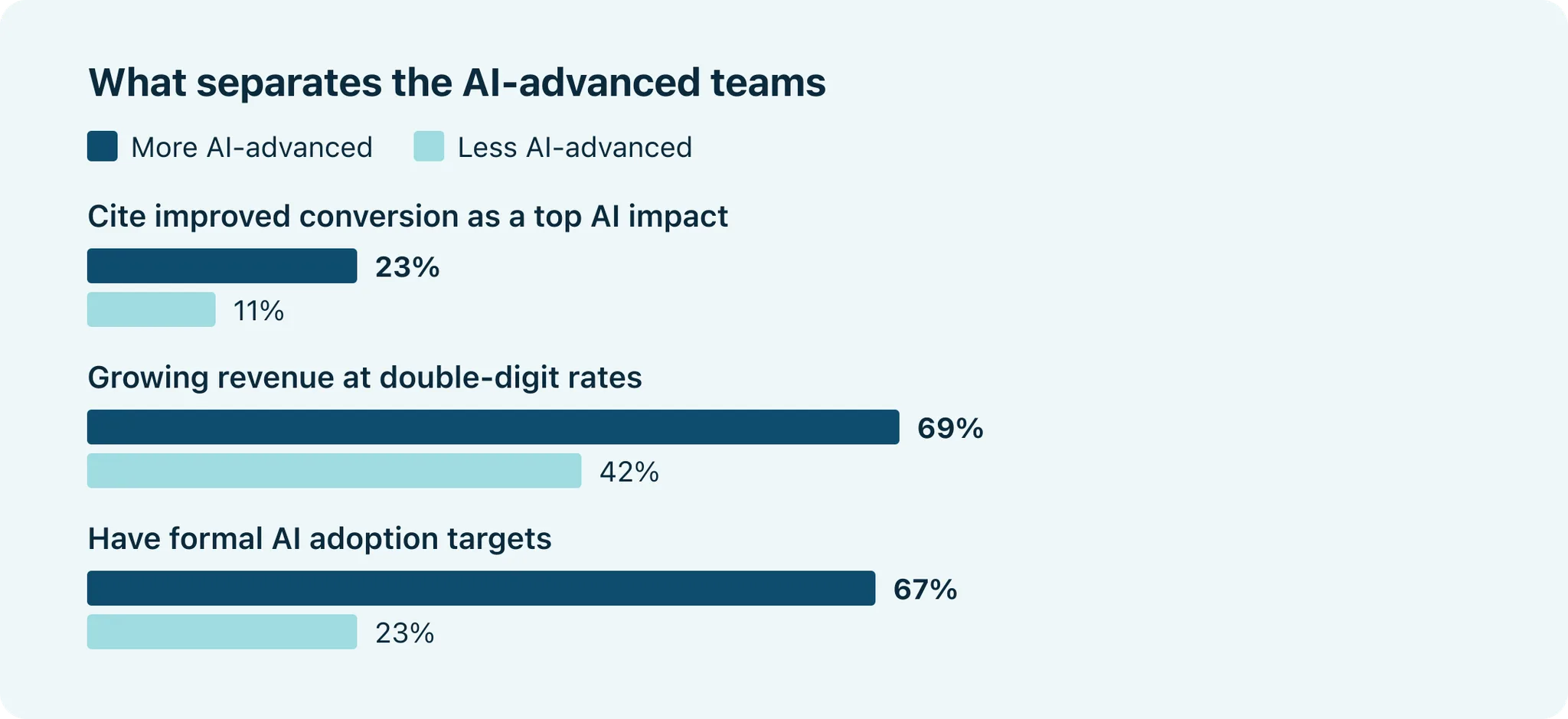
- They're twice as likely to cite improved conversion as a top area of AI impact (23% vs. 11%)
- They're more likely to be growing revenue at double-digit rates (69% vs. 42%)
- They're far more likely to have formal AI adoption targets (67% vs. 23%)
Gong's research on AI adoption depth points the same way. Teams that embedded AI into their core go-to-market strategy were 65% more likely to increase win rates than teams treating it as optional.
According to BCG, the CROs furthest along push AI into the customer-facing, judgment-heavy parts of the sales cycle, and they redirect the time it frees up toward customers. BCG's Nacho Hafner frames the goal as helping sellers understand their clients, prepare more relevant conversations and decide where to focus their effort.
What Five Saved Hours Are Worth
To see why targeting matters as much as tooling, take one rep and follow the time AI gives back. The numbers below are illustrative. Plug in your own.
| Same accounts as before | Best-fit accounts | |
|---|---|---|
| Hours saved per week by AI | 5 | 5 |
| Selling weeks per year | 46 | 46 |
| Hours redirected to selling | 230 | 230 |
| Opportunities that time supports (about 10 hours each) | 23 | 23 |
| Win rate on those opportunities | 20% | 30% |
| Additional deals per rep per year | 4.6 | 6.9 |
Same AI, same hours, same rep. The only difference is where the time goes, and it's worth roughly 50% more closed deals. Across a team of 20 reps, that's the difference between about 92 and 138 extra wins a year.
This is why BCG argues success in 2027 should be measured by how sellers use the time, not just by how much time AI saves.
How to Measure AI in 2027
If the 2026 scorecard was adoption and hours saved, the 2027 scorecard needs to follow the time into pipeline and revenue.
| The 2026 AI scorecard | The 2027 AI scorecard |
|---|---|
| Percent of reps using AI tools | Win rate by segment, before and after AI rollout |
| Hours saved per seller per week | Share of those hours spent on best-fit accounts |
| Emails and sequences generated | Conversion from first meeting to qualified opportunity |
| CRM fields auto-filled | Whether reps can explain why each target account fits |
| Forecast accuracy | How early sellers show customer-specific proof of value |
Ocean.io's Discovery view breaks your deals into segments with their own win rate, revenue and sales cycle, which gives you the first row of that scorecard from day one.
A useful sequence for putting this into practice runs from context to action:
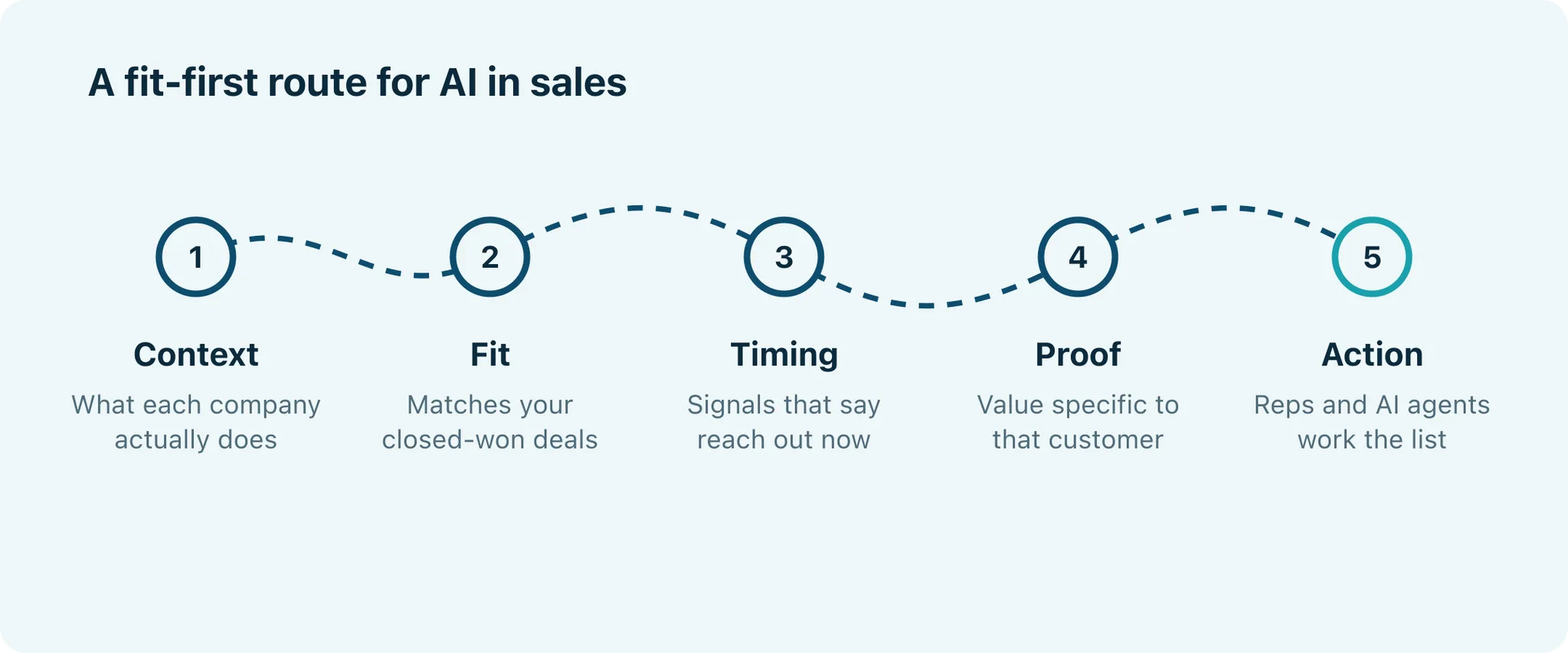
- Context: understand what each company in your market actually does and who it sells to, beyond its industry code.
- Fit: compare every account to the customers who already bought and stayed, and rank them.
- Timing: layer in signals such as hiring, funding or technology changes to decide who to reach first.
- Proof: use what you know about the account to build customer-specific value early, before the buyer asks.
- Action: let reps, sequences and AI agents work accounts that were chosen well.
Most AI sales tooling lives at step five. The data suggests the biggest gains come from getting steps one through four right first.
What to Do Next
Most AI sales tools work on accounts that have already been chosen. Ocean.io works on the step before that. Its contextual intelligence reads what companies actually do, learns your ICP from closed-won deals and ranks every company in your market by fit, with the reasons behind each recommendation. It reaches Salesforce, HubSpot and Slack, and AI assistants like Claude through MCP, so the AI your team already uses starts from better accounts. If you're weighing options, see how Ocean.io compares to other GTM data tools.
- Tie AI targets to conversion and win rate by segment, not usage, the way BCG's AI-advanced teams do.
- Rebuild your ICP from closed-won deals, then check how much of your reps' saved time lands on accounts that match it.
- Move customer-specific proof of value ahead of the first call, since most buyers arrive with their shortlist already ranked.
Frequently Asked Questions
What is the "do more with more" revenue agenda?
It's BCG's term for 2027 plans that grow headcount (65%), budget (72%) and quota (91%) together, which makes choosing the right accounts, the job Ocean is built for, matter more.
How many sales teams use AI in 2026?
Nearly all of them (90% per BCG), but only 6% run autonomous end-to-end AI, so the gap is depth and starting with better accounts, not adoption.
Does AI improve sales win rates?
For a minority so far: only 13% of leaders cite better win rates, though teams that point AI at the right accounts, as Ocean's fit scoring does, are the ones pulling ahead.
What is the average sales quota attainment in 2026?
It depends on the study, from 46% (Gong Labs) to 62% (Salesloft), but all three show attainment slipping as quotas rise.
How should revenue leaders measure the ROI of AI in sales?
Track win rate and the share of rep time spent on best-fit accounts, which Ocean's ranked account lists help you see, instead of hours saved or adoption.